







Key Takeaways
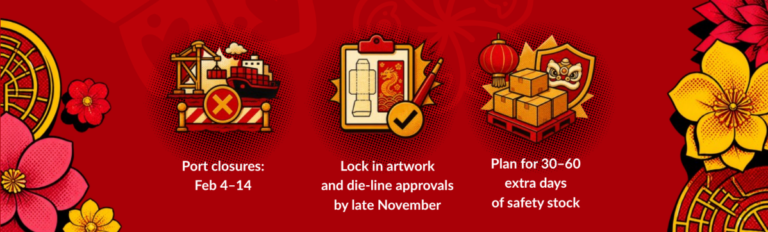
- Lock in artwork and die-line approvals by late November so production wraps up before the February 4-14 port closures.
- Order by Thanksgiving for the smoothest timeline. Later orders shift into tighter, costlier Clutch or Rush windows.
- Domestic backup suppliers can’t match offshore pricing and production capabilities, so planning ahead beats a last-minute switch.
The Lunar New Year drives the largest annual human migration on the planet. Employees travel from coastal manufacturing hubs back to their home provinces. Manufacturing downtime alone typically runs 10 days to three weeks, but the disruption starts even earlier than that.
If you source bags, cartons, or flexible materials overseas, mark your calendar now. Ordering by Thanksgiving gives you the smoothest path through the closure.
The Timeline: Critical Milestones for Packaging Orders
Chinese New Year follows the lunar calendar, so its dates shift every year between late January and mid-February. Buyers who plan around a fixed calendar date usually miss their cutoffs. Instead, work backward from the holiday using three checkpoints: approvals, production, and shipping.
Your order date decides how much room you have to work with. Three timeframes define your options:
- Recommended Timeframe: Order by Thanksgiving, as this gives your supplier ample prep time to finalize production and book cargo without rush work.
- Clutch Timeframe: Order by mid-December. While timeframes are still workable, your supplier will be operating on a tighter schedule with firmer deadlines.
- Rush Timeframe: Late December is your final deadline for one-month delivery needs, though you should expect premium pricing and limited options. Keep in mind that other businesses will also be rushing orders, making production schedules tighter and harder to meet.
October to November: Approvals and Artwork
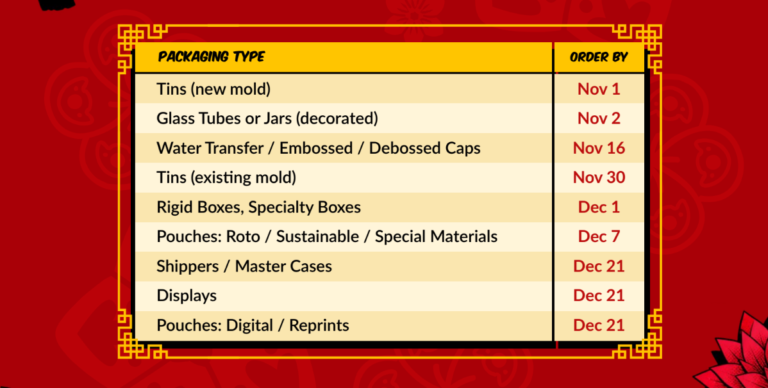
This is when structural engineering, die lines, and artwork need to be finalized. Custom packaging often needs tooling, printing plates, or custom mold work, and that takes weeks to complete. Tins and custom glass carry the longest lead times. Tins can take up to 40 days, and custom-decorated jars or bottles run about five weeks. Boxes and pouches typically take about three weeks in normal production, and every one of these timelines stretches further once the pre-holiday rush hits. Lock in every structural and artwork approval by late November, before revisions eat into your production window. Color matching and proofing add another review cycle.
December: Production and Cargo Booking
Once mass production starts, the clock is already ticking tight. Every product category, not just packaging, competes for the same Chinese manufacturing base during this window. Toy companies, apparel brands, electronics makers, and packaging buyers like you all draw from the same provinces, ports, and trucking networks. That volume stresses the entire system, so production and delivery timelines run longer than they would the rest of the year.
Your freight forwarder should already be booking cargo space by this point. Shipping rates on Lunar New Year packaging routes tend to spike in the weeks before the holiday. Booking early protects your freight budget from peak-season surcharges, and it secures space before carriers start canceling sailings.
January: Getting Containers on the Water
The goal is simple. Get your packaging ordered, produced, loaded, and on the water before the port closures hit. Cargo still sitting on the dock when the holiday begins can stay stuck there for nearly a month.
Beware of the “Post-Holiday Hangover” in Manufacturing
The “post-holiday hangover” catches many procurement teams off guard. Some employees may choose to stay home or take new work elsewhere and this can often cause a few delays as manufacturers hire and train replacements and maintain previous production times.
How to Calculate Your Q1 Packaging Safety Stock
Most supply chains need 30 to 60 extra days of safety stock heading into Q1. That buffer covers the factory closure, the slower post-holiday ramp-up, and any delays from canceled sailings. Standard just-in-time ordering is risky during this window.
Here’s a simple framework for calculating your buffer:
- Determine baseline Q1 + April demand. Review your January-through-April sales data. Include any new product launches or promotions that will increase packaging use.
- Add a disruption buffer. Build in 30 to 60 extra days beyond your normal reorder point to cover the closures and the slow restart.
- Check your warehousing capacity. Bulky custom product packaging takes up real shelf space. Confirm you can store the extra stock, or arrange staggered domestic deliveries instead. Packaging Options USA and Treeform Packaging Solutions can help with warehousing if needed.
What to Do If You Miss the Lunar New Year Packaging Cutoff
If ocean freight is no longer an option, try to avoid defaulting to air freight. Everyone ships air occasionally, but airfreighting bulky packaging is expensive, and it erodes your margins fast. Domestic backup suppliers keep production moving onshore while offshore manufacturing stays closed. However, many domestic partners may not match offshore production rates or MOQs, and they often have longer production schedules. That’s undoubtedly why planning ahead matters more than the backup itself. Order by Thanksgiving, and you likely will never need it.
A dual-source strategy is the better long-term answer. Packaging Options USA and Treeform Packaging Solutions pair offshore manufacturing for cost efficiency with domestic manufacturing for speed when you need it, so a missed international deadline doesn’t have to mean an empty shelf. It will cost more than planning ahead would have, though it will keep you covered.
Chinese New Year is not the time to test new materials and prototypes. A rushed pivot under pressure means qualifying unfamiliar options without the runway to test them properly. Many domestic manufacturers offer fewer eco-friendly choices to test, carry higher minimum order quantities, and still source their own raw materials overseas. If sustainability sits on your roadmap, work with eco friendly packaging companies well before the closure, on your normal timeline, not as an emergency swap.
Chinese New Year packaging planning comes down to three moves:
- Lock in your timeline early.
- Tighten quality control before and after the holiday.
- Know your domestic backup option, and plan early enough that you don’t pay its premium.
Brands that treat Lunar New Year packaging as a seasonal certainty, not as a surprise, protect both their margins and their shelves.
Ready to Lock In Your Chinese New Year Packaging Plan?
Whether you’re mapping out this year’s production schedule or scrambling after a missed cutoff, our team can build a domestic backup plan. We’ll help keep your shelves stocked through Q1.
Order by Thanksgiving for the smoothest timeline. Later orders shift into tighter Clutch (mid-December) or Rush (late December) windows with premium pricing.
Order enough to cover your needs through April 2027. Plan for 30 to 60 extra days beyond your normal reorder point to cover the closure and the slower restart.
A domestic manufacturing partner can bridge the gap while offshore factories stay closed. Expect higher rates than offshore, which is why ordering early pays off.